50 Grams to Cups: Easy Ingredient Conversion Guide
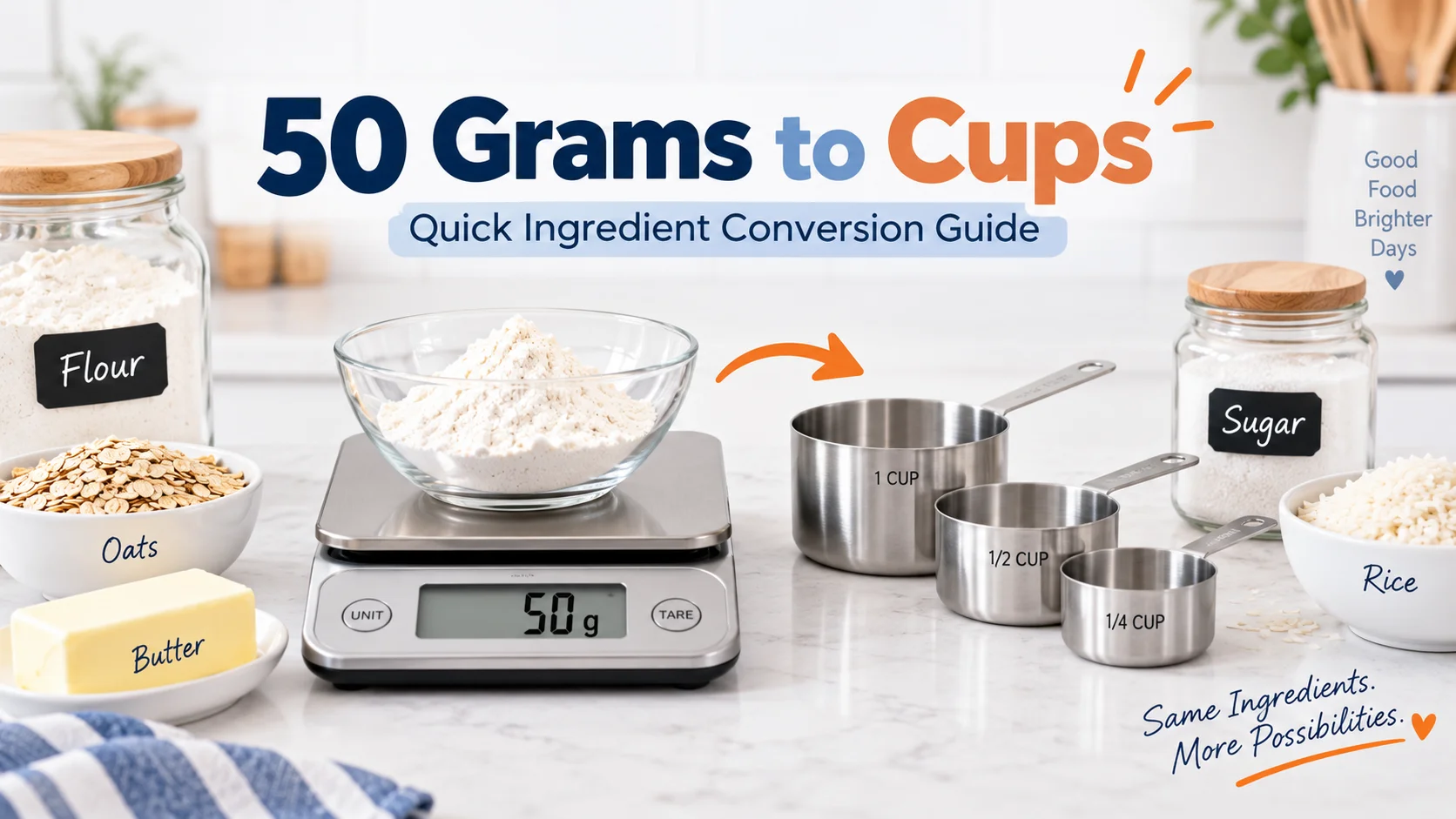
Need to convert 50 grams to cups? The answer depends on the ingredient. Grams measure weight, while cups measure volume, so 50 grams of flour does not fill the same amount of a cup as 50 grams of sugar, butter, oats, or honey.
Use the quick answers below, check the ingredient chart, or use our converter to get a result based on the ingredient you are measuring.
50 grams of all-purpose flour = 0.40 US cup, which is about ⅜ cup as a practical kitchen fraction. The result changes when you choose another ingredient.
50 Grams to Cups Converter
Preset to 50 grams — choose your ingredient for an instant cups conversion.
50g ÷ 125g per cup = 0.4 cups
Why ingredient matters: grams measure weight while cups measure volume. Different ingredients have different densities, so 50 grams of flour does not equal the same number of cups as 50 grams of sugar or butter.
50 Grams to Cups Conversion Chart
The chart below shows how much 50 grams is in cups for common cooking and baking ingredients. These values use a US customary cup and the same ingredient values used by our converter.
| Ingredient | 50g in Cups | Kitchen Fraction | Tablespoons |
|---|---|---|---|
| All-Purpose Flour | 0.40 cup | ≈ ⅜ cup | 6.4 tbsp |
| Bread Flour | 0.39 cup | ≈ ⅜ cup | 6.3 tbsp |
| Cake Flour | 0.44 cup | ≈ ½ cup | 7.0 tbsp |
| Whole Wheat Flour | 0.42 cup | ≈ ⅜ cup | 6.7 tbsp |
| Almond Flour | 0.52 cup | ≈ ½ cup | 8.3 tbsp |
| Granulated Sugar | 0.25 cup | ¼ cup | 4 tbsp |
| Brown Sugar, Packed | 0.23 cup | ≈ ¼ cup | 3.8 tbsp |
| Powdered Sugar | 0.42 cup | ≈ ⅜ cup | 6.7 tbsp |
| Butter | 0.22 cup | ≈ ¼ cup | 3.5 tbsp |
| Milk | 0.20 cup | ≈ ¼ cup | 3.3 tbsp |
| Water | 0.21 cup | ≈ ¼ cup | 3.4 tbsp |
| Rolled Oats | 0.56 cup | ≈ ½ cup | 8.9 tbsp |
| White Rice, Uncooked | 0.27 cup | ≈ ¼ cup | 4.3 tbsp |
| Honey | 0.15 cup | ≈ ⅛ cup | 2.4 tbsp |
| Cocoa Powder | 0.59 cup | ≈ ⅝ cup | 9.4 tbsp |
| Chocolate Chips | 0.29 cup | ≈ ⅓ cup | 4.7 tbsp |
| Peanut Butter | 0.19 cup | ≈ ¼ cup | 3.1 tbsp |
| Olive Oil | 0.23 cup | ≈ ¼ cup | 3.7 tbsp |
| Cornstarch | 0.39 cup | ≈ ⅜ cup | 6.2 tbsp |
| Table Salt | 0.17 cup | ≈ ⅛ cup | 2.8 tbsp |
How to Convert 50 Grams to Cups
To convert grams to cups, you need the grams-per-cup value for the ingredient. This matters because a cup of flour does not weigh the same as a cup of sugar, butter, or oats.
For all-purpose flour, our converter uses about 125 grams per US cup.
50 ÷ 125 = 0.40 cupSo 50 grams of all-purpose flour is about 0.40 US cup.
For more detail about our method, see How We Calculate Grams to Cups.
Why 50 Grams Is Not a Fixed Number of Cups
Grams tell you how heavy something is. Cups tell you how much space it takes up. That is why one fixed conversion cannot work for every ingredient.
Flour contains tiny air spaces, while granulated sugar packs together more tightly. Honey is denser still. So the same 50-gram weight can occupy very different amounts of cup space.
50g Flour to Cups
50 grams of all-purpose flour is about 0.40 cup. Our flour reference is 125 grams per US cup.
50g Sugar to Cups
50 grams of granulated sugar is 0.25 cup, or ¼ cup.
50g Butter to Cups
50 grams of butter is about 0.22 cup, a little less than ¼ cup.
50g Oats to Cups
50 grams of rolled oats is about 0.56 cup. Oats are light, so 50 grams takes up more cup space.
50g Rice to Cups
50 grams of uncooked white rice is about 0.27 cup. Cooked rice should not use the same conversion.
50g Honey to Cups
50 grams of honey is about 0.15 cup because honey is much denser than flour or oats.
Does the Cup Size Matter?
Yes. The table on this page uses a US customary cup. Different countries and recipes may use another cup standard.
| Cup Standard | Volume | Common Use |
|---|---|---|
| US Customary Cup | 236.6 ml | Common US recipes |
| US Legal Cup | 240 ml | Nutrition and labeling |
| Metric Cup | 250 ml | Many metric recipes |
| Imperial Cup | 284.1 ml | Older Imperial references |
If your recipe uses another standard, choose the correct cup size in the converter instead of relying only on the chart.
For an authoritative reference on common household cooking measures, see the NIST Metric Kitchen measurement equivalencies.
How to Measure 50 Grams More Accurately
A digital kitchen scale is the simplest choice when a recipe gives the amount in grams. Place your bowl on the scale, press tare, and add the ingredient until the display reaches 50g.
If you must use a measuring cup, pay attention to the ingredient. Flour should normally be spooned lightly into the cup and leveled. Packed brown sugar is measured differently. Liquids should be read at eye level.
Our How to Use the Grams to Cups Converter guide explains the tool step by step.
For another established baking reference, you can compare common ingredient weights with the King Arthur Baking Ingredient Weight Chart. Different references can use slightly different values, so this site keeps one consistent internal database across its conversion pages.
Useful Grams to Cups Resources
Use these pages when you need another amount or want to understand the conversion in more detail.
Trusted Measurement References
NIST Metric Kitchen — useful for household cooking measurement equivalencies and cup-size context.
King Arthur Baking Ingredient Weight Chart — useful for comparing common baking ingredient weights.
Other Popular Grams to Cups Amounts
Use these live guides when your recipe calls for a different amount.
Frequently Asked Questions
How many cups is 50 grams?
There is no single answer because the ingredient matters. For example, 50 grams of all-purpose flour is about 0.40 cup, while 50 grams of granulated sugar is 0.25 cup.
How many cups is 50 grams of flour?
Using 125 grams per US cup for all-purpose flour, 50 grams is about 0.40 cup, or roughly ⅜ cup as a practical kitchen fraction.
How many cups is 50 grams of sugar?
50 grams of granulated sugar is 0.25 US cup, or ¼ cup, using 200 grams per cup.
How many cups is 50 grams of butter?
50 grams of butter is about 0.22 US cup, which is a little less than ¼ cup.
Is 50 grams the same as 50 milliliters?
Not in general. Grams measure weight and milliliters measure volume. The relationship changes with ingredient density.
Can I measure 50 grams without a kitchen scale?
Yes, if you know the ingredient. Use the chart or converter to estimate cups, tablespoons, or teaspoons. A scale is still the better choice when accuracy matters.
Final Answer
The conversion of 50 grams to cups depends on the ingredient. For all-purpose flour, 50g is about 0.40 cup. For granulated sugar, it is 0.25 cup, while 50g of butter is about 0.22 cup.
Use the chart for a quick reference or use the converter above when you want to choose the exact ingredient and cup standard.