

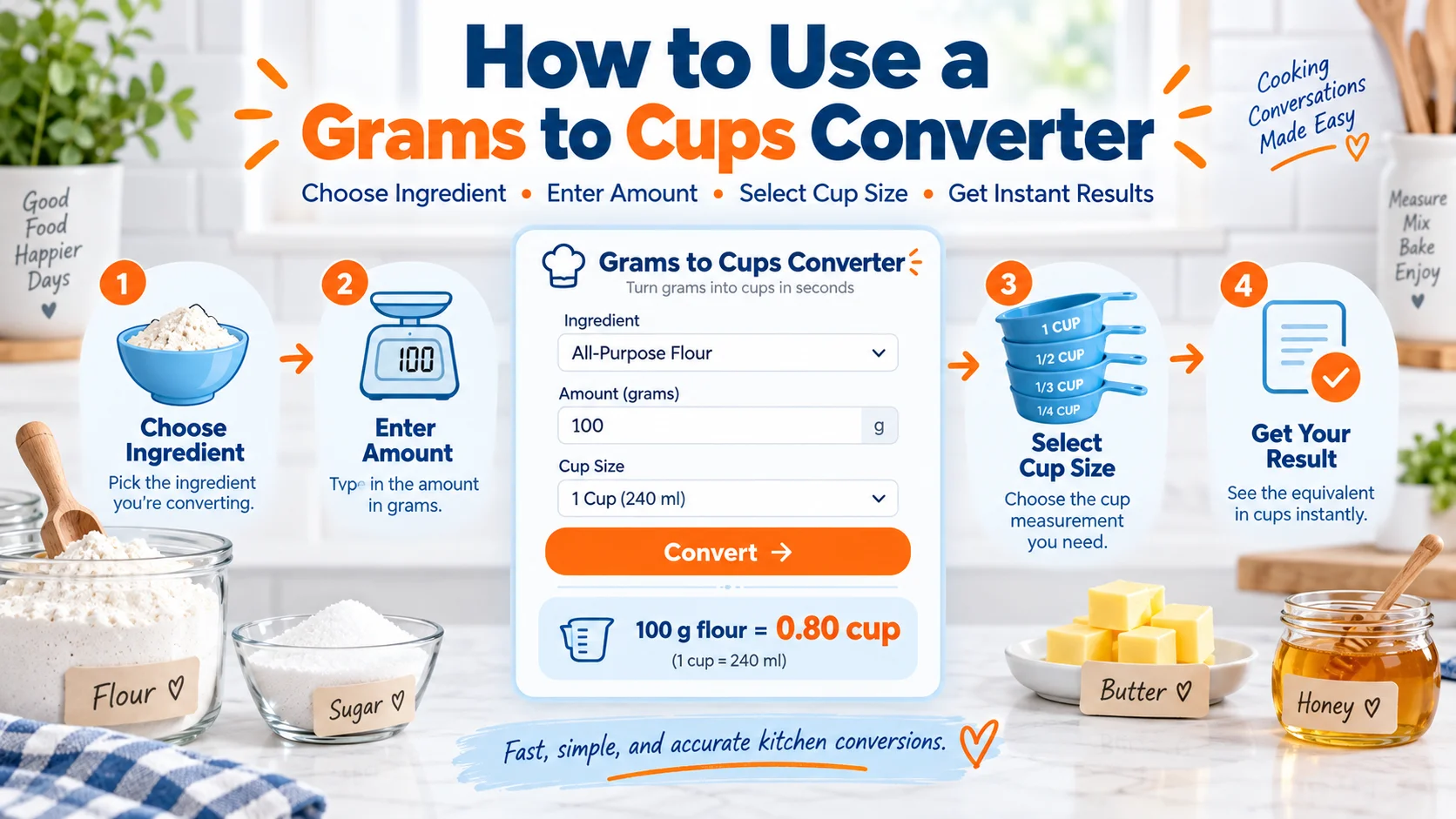
Using a kitchen converter should not feel hard. Our tool helps you change grams to cups or cups to grams in just a few clicks. If you want to know how to use a grams to cups converter, choose the ingredient, enter the amount, select the cup size used by your recipe, and read the result.
You can use it for flour, sugar, butter, rice, oats, milk, honey, cocoa powder, and many other ingredients. The result also shows useful kitchen measurements such as fractions, tablespoons, teaspoons, and the calculation formula.
How to Use the Grams to Cups Converter
Choose the Direction
Select Grams → Cups when your recipe gives grams, or Cups → Grams when you want the ingredient weight.
Select Your Ingredient
Choose the exact food. Flour, sugar, butter, oats, honey, and other foods do not weigh the same per cup.
Enter the Amount
Type the number you need, such as 50g, 100g, 150g, or 200g, or use a quick button.
Choose the Cup Standard
Select US, US Legal, Metric, or Imperial cup according to the recipe.
Read the Result
See cups or grams plus a practical fraction, tablespoons, teaspoons, and the formula.
Copy, Share, or Reset
Save the conversion, share it, or reset the tool and start again.
Grams to Cups Converter
Practice the steps above with a live conversion.
100g ÷ 125g per cup = 0.8 cups
Step 1: Choose Grams to Cups or Cups to Grams
Choose Grams → Cups if your recipe gives a weight in grams and you need cups. Choose Cups → Grams if you have a cup amount and want to weigh the ingredient on a kitchen scale.
Grams → Cups Example
100g all-purpose flour → about 0.80 US cup.
Cups → Grams Example
1 cup granulated sugar → about 200g in our site’s conversion system.
Step 2: Select Your Ingredient
This step is important. A cup of flour does not weigh the same as a cup of sugar. Butter, honey, rice, oats, and other foods also have different weights.
For more detail about the method behind the result, read How We Calculate Grams to Cups.
Step 3: Enter the Amount
Type the amount from your recipe into the input box. If you are converting grams to cups, you can enter values such as 50g, 75g, 100g, 125g, 150g, 175g, or 200g. The quick buttons save time on common amounts.
Step 4: Choose Your Cup Size
Not every cup standard is the same size. Select the one that matches your recipe.
| Cup Standard | Volume | Typical Use |
|---|---|---|
| US Customary Cup | 236.6 ml | Common US cooking and baking |
| US Legal Cup | 240 ml | Food labeling and some references |
| Metric Cup | 250 ml | Many metric recipes |
| Imperial Cup | 284.1 ml | Older Imperial references |
Step 5: Read Your Result
Once you enter the amount, the converter shows the main result and useful kitchen equivalents. For example, 100 grams of all-purpose flour → about 0.80 US cup using our reference value.
The result also includes a practical kitchen fraction, tablespoons, teaspoons, and the formula.
What Does the Kitchen Fraction Mean?
Decimal cup values are useful for calculation, but they are not always easy to measure. A kitchen fraction gives you a familiar measuring-cup value when possible. For example, 0.50 cup is ½ cup and 0.75 cup is ¾ cup.
Can I Copy or Share the Result?
Yes. Use Copy Result to save the conversion in notes, a recipe, or a message. Use Share when your browser supports it. Choose Reset to return the tool to its default setting.
Why Results Can Differ Between Websites
Ingredient weight references are not always identical. Flour is a good example: different baking references may use slightly different grams-per-cup values because of measuring method, packing, ingredient condition, or rounding.
For consistency, Grams To Cup Hub uses one fixed internal ingredient database across the converter and amount pages. You can read the method on our How We Calculate page.
Trusted Measurement References
NIST Metric Kitchen
NIST provides household cooking measurement equivalencies and practical culinary measurement guidance.
View NIST measurement equivalencies →King Arthur Ingredient Weight Chart
King Arthur Baking publishes a searchable chart of volume, ounce, and gram values for common baking ingredients.
View ingredient weight chart →Popular Grams to Cups Examples
Open a dedicated guide when you want ingredient charts and a converter already preset to a common gram amount.
Try a Common Gram Amount
These guides are already part of our grams-to-cups cluster.
Tips for Better Kitchen Measurements
Use the correct ingredient every time. Check whether your recipe uses US, metric, or another cup standard. For flour, avoid packing it into a measuring cup unless the recipe tells you to do so. For liquid measurements, use a level surface and read the measurement carefully.
When a baking recipe gives grams, a digital kitchen scale is often the simplest way to keep measurements consistent.
Frequently Asked Questions
How do I use a grams to cups converter?
Choose the ingredient, enter the number of grams, select the cup standard, and read the result. The converter also shows a practical fraction, tablespoons, teaspoons, and the formula.
Do I need to choose an ingredient?
Yes. Different ingredients have different densities, so the ingredient changes the grams-to-cups result.
Can I convert cups back to grams?
Yes. Select Cups → Grams, choose the ingredient, enter the cup amount, and the converter will show the weight in grams.
Which cup size should I choose?
Use the cup standard used by your recipe. The converter includes US customary, US legal, metric, and Imperial cup options.
Why does 100 grams give different cup amounts?
Because grams measure weight and cups measure volume. Flour, sugar, butter, honey, oats, and other ingredients have different densities.
Is the converter useful for baking?
Yes. It helps when a recipe uses grams but you need cups, or when a recipe uses cups and you prefer to weigh ingredients on a kitchen scale.
Start Your Conversion
Now you know how to use a grams to cups converter. Choose your ingredient, enter the amount, select your cup standard, and get the result in seconds.
Open the Main Grams to Cups Converter →Need the math behind each result? Read How We Calculate.